
How AI Agents Are Reshaping Workflows for Startups and Mid-Sized Businesses
Unpacking the evolution from basic assistants to autonomous agents - and why it matters for the future of business.

Companies are rapidly deploying autonomous AI “agents” as virtual helpers across functions - and the results are striking.
According to a recent PwC survey, 79% of companies report using agentic AI today, and two-thirds (66%) say these agents have already boosted productivity.
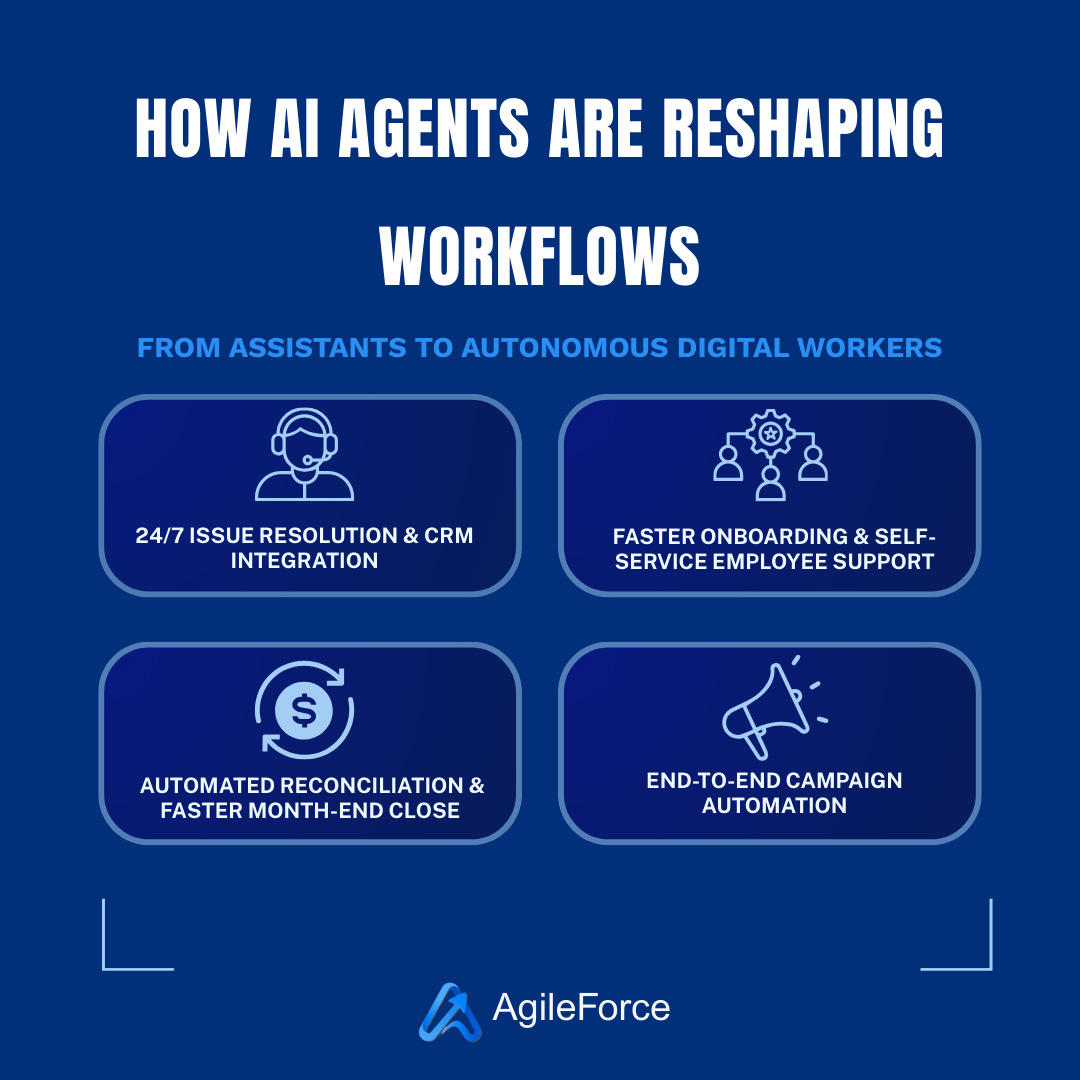
In practice, leading businesses now treat AI agents as “digital workers” to streamline everyday processes.
For example, IBM notes that AI agents are already smoothing out workflows in customer support, marketing, HR and finance.
By automating routine work, startups and mid-sized firms can focus human talent on higher-value projects.
Customer Support and Sales
Consider customer service: AI phone and chat agents can do far more than give canned answers. Modern agents use natural language understanding and tool-calling to take action.
Gartner predicts that by 2029, 80% of routine support issues will be handled entirely by autonomous agents, without human hand-off.
In effect, these AI helpers can identify a caller’s intent, open or update tickets, even route cases to experts - acting like an always-on service rep.
By integrating with CRM and helpdesk systems, AI agents bridge knowledge gaps and execute tasks, so a query never gets “lost in the shuffle”.
In the hands of small teams, this means 24/7 support and a big lift in customer satisfaction with a lean headcount.
HR Onboarding and Employee Experience
New-hire onboarding and HR queries are another natural fit.
AI agents can guide employees through paperwork, benefits enrollment and training schedules.
In one real-world example, a large firm (Hitachi) cut its onboarding cycle by four days using an AI assistant, and slashed HR’s time per new hire from 20 hours to 12.
Likewise, IBM reports that its AskHR agent now answers 94% of routine employee questions, letting HR staff focus on complex, high-touch interactions.
By automating forms, FAQs, and training workflows, AI agents free HR to do what machines can’t - build personal connections - while handling the rest.
Finance and Reconciliation
In finance departments, AI agents can tackle tedious, multi-step tasks like bookkeeping and bank reconciliation. Advanced systems now achieve up to a 90% match rate on transactions and auto-post 95% of journal entries through smart rule engines.
This is more than idle hype: one finance AI claimed it helped a company close books 75% faster, and in general AI-assisted teams report month-end close times dropping by nearly 30%.
AI agents bring context-awareness to reconcile invoices, flag anomalies, and prepare variance reports all in one flow.
Rather than hunting data in silos, a CFO can ask an agent “Why did costs jump last quarter?” and get an answer rooted in the company’s ledgers and policies, plus a list of suggested actions.
The bottom line: finance pros spend less time copying numbers and more time advising on strategy.
Marketing and Growth Automation
Marketing is being reinvented by AI agents that do much more than schedule tweets. Agents in marketing can reason about campaigns and execute them.
IBM reports half of companies using generative AI will pilot full agentic systems by 2025.
These agents craft personalized emails, launch social media ads, adjust bids, and analyze performance without constant human prompts.
For instance, an agent might recognize a lead’s intent, automatically send a tailored offer, update the CRM, and queue follow-ups - all on its own.
As IBM’s example shows, AI marketing agents can manage email, social, SEO, and pricing strategies end-to-end, freeing teams from routine execution.
The result is smarter marketing at scale: faster campaign cycles, more data-driven targeting, and continual learning as agents adjust tactics over time.
The common thread is that modern AI agents don’t just answer questions - they act on them.
They connect to enterprise tools via APIs, create tickets, update records, send messages and more as part of a workflow.
In practice, agents work alongside people: humans set goals and guardrails, and agents execute tasks autonomously.
To make this work safely for growing businesses, purpose-built platforms are emerging.
For example, AgileForce designs systems so that “AI agents understand an organization’s context, automate processes with human fallback, and reduce operational risk”.
In other words, startups can deploy scalable, workflow-specific agents with confidence - amplifying their team’s capacity without losing control.
Taken together, these real-world examples show that agentic AI is already reshaping workflows for startups and mid-market companies.
By automating customer service, onboarding, finance and marketing tasks, AI agents free people to focus on innovation.
With agile, system-savvy platforms backing them, these intelligent agents act as force multipliers - making small teams punch well above their weight.